
AI needs power, so why is the biggest utility ETF cheaper than usual? On 6 October Google signed a 20-year contract to buy nuclear power from Constellation Energy, the latest tech company to lock in electricity for its AI data centres, and Constellation’s shares jumped on the news. Yet XLU, the fund most investors use to own utilities, trades near its cheapest since 2017 on next year’s earnings.
Both can be true because XLU holds two different kinds of utility. A small group of power producers sells electricity at market prices, data centres included, and the market prices them like growth companies. The large majority are regulated utilities that earn a return set by state regulators, and they trade more like a bond.
Split the fund in two
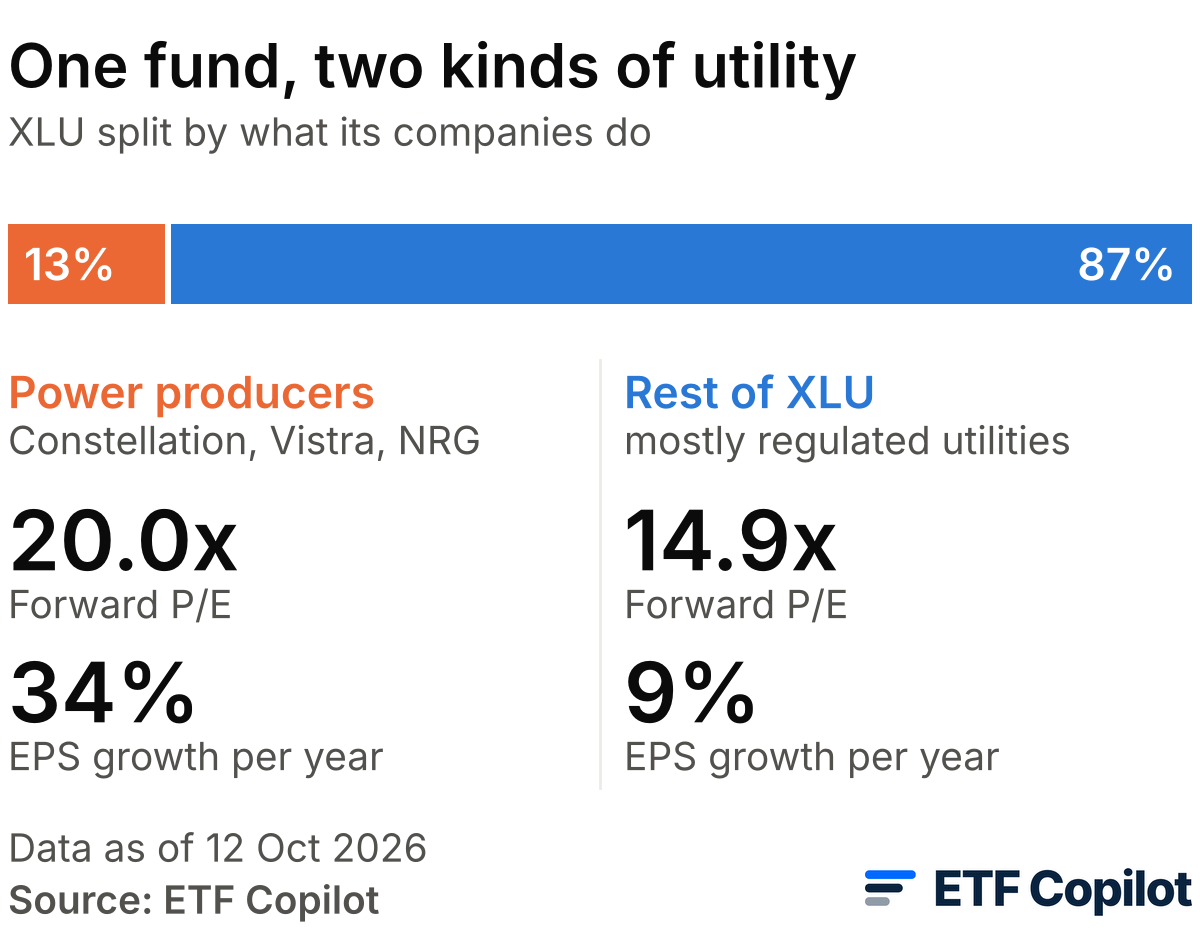
Constellation, Vistra and NRG make up 13% of XLU. Analysts expect their earnings to grow about 34% a year, and together they trade at 20x next year’s earnings.
The other 87% trades at about 15x, with growth at a utility’s usual pace.
Investors who specialise in the sector see the same split. Jay Rhame, chief executive of Reaves Asset Management, which runs the UTES utility fund, said in September that the dispersion inside the sector “is as wide as it’s ever been.”
Priced for growth, priced for income
At 20x, the power producers are priced close to the S&P 500, at 19x for SPY, and are expected to grow faster than the index. The regulated rest, at 15x, is priced for its dividend.
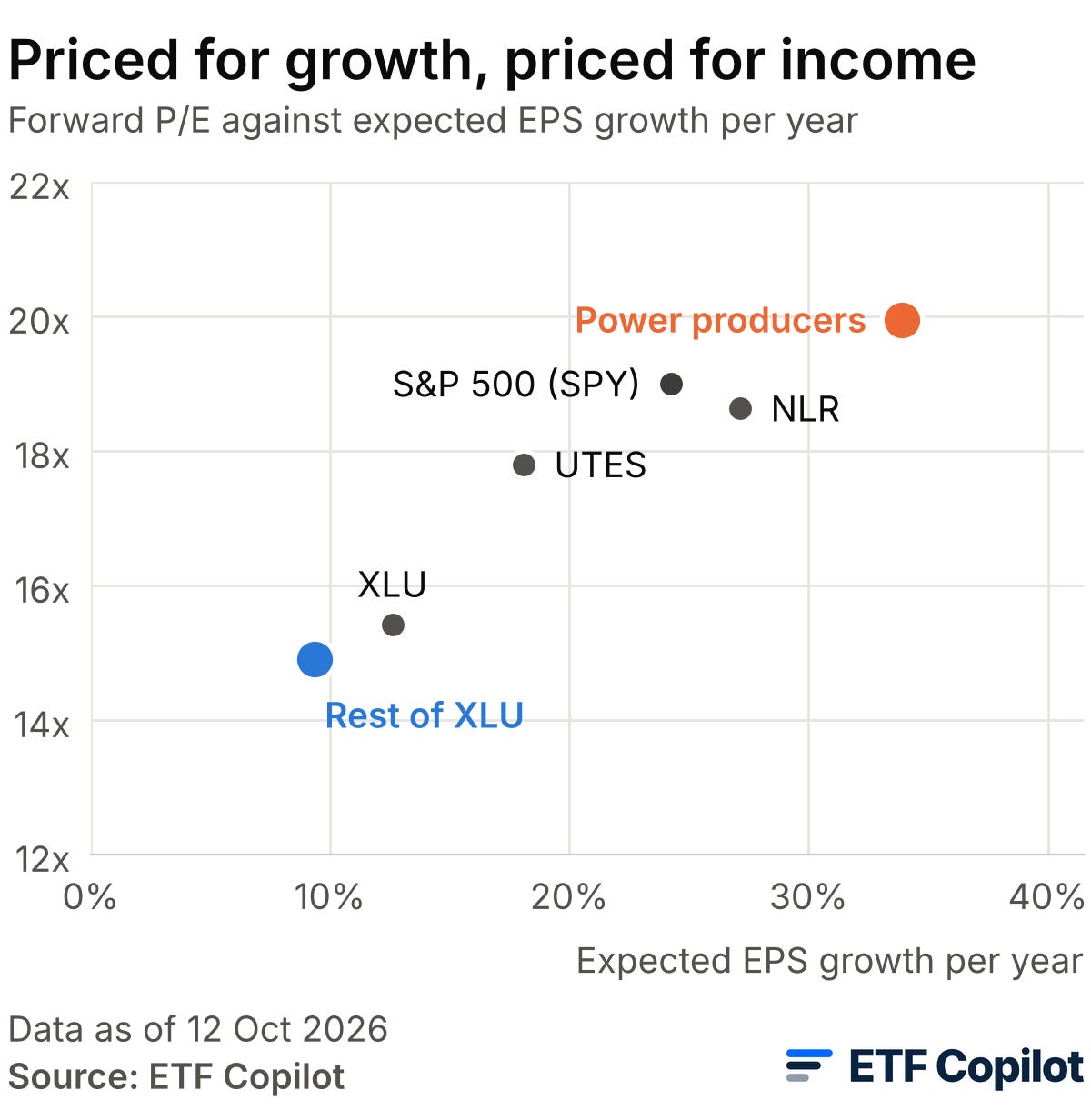
Funds tilted toward the AI power trade cost more. UTES, with about two-fifths in power producers, trades at 18x, and NLR, VanEck’s nuclear fund, at 19x, more expensive than 79% of its own history.
Why the bigger part is cheap
Regulated utilities are bought for steady income, and income now has competition. XLU pays about 3% in dividends against 1% for the S&P 500, but the 10-year Treasury yielded 5.22% on 8 October.
The Federal Reserve raised its target range to 3.75% to 4% on 16 September, saying inflation “remains elevated”, and the minutes released on 7 October show most officials expect another increase by year end.
The pressure shows in the whole fund. At 15.4x next year’s earnings, XLU is cheaper than 98% of its own history since 2017. Analysts’ estimates of its companies’ earnings over the next year are about 13% higher than a year ago, yet the fund lost 5% including dividends. Money is starting to come in: about $0.9bn went into XLU in the week to 12 October.
What an XLU holder owns
XLU’s holders mostly own the regulated grid, whose price moves with bond yields, plus a slice of the AI power trade. The discount comes with slow growth for most of the fund, and a dividend that bonds now beat.
See the full breakdown on ETF Copilot: etf-copilot.com/go/substack/xlu-two-businesses
Written by the ETF Copilot research team. Data as of 12 October 2026. ETF Copilot has no business relationship with, and receives no compensation from, the issuers of the funds mentioned. Managers of ETF Copilot may or may not hold positions in the funds mentioned. Not investment advice.
Sources: Google and Constellation agreement, Reuters, 6 Oct 2026; Jay Rhame in CIO, 1 Sep 2026; FOMC statement, 16 Sep 2026; FOMC minutes, released 7 Oct 2026; 10-year Treasury yield, FRED.