
Owning SPY is a lot like checking the national weather on an autumn afternoon. The map says a mild 65°F. The average is right, and it tells you nothing about the 95°F in Miami or the 35°F in Minneapolis.
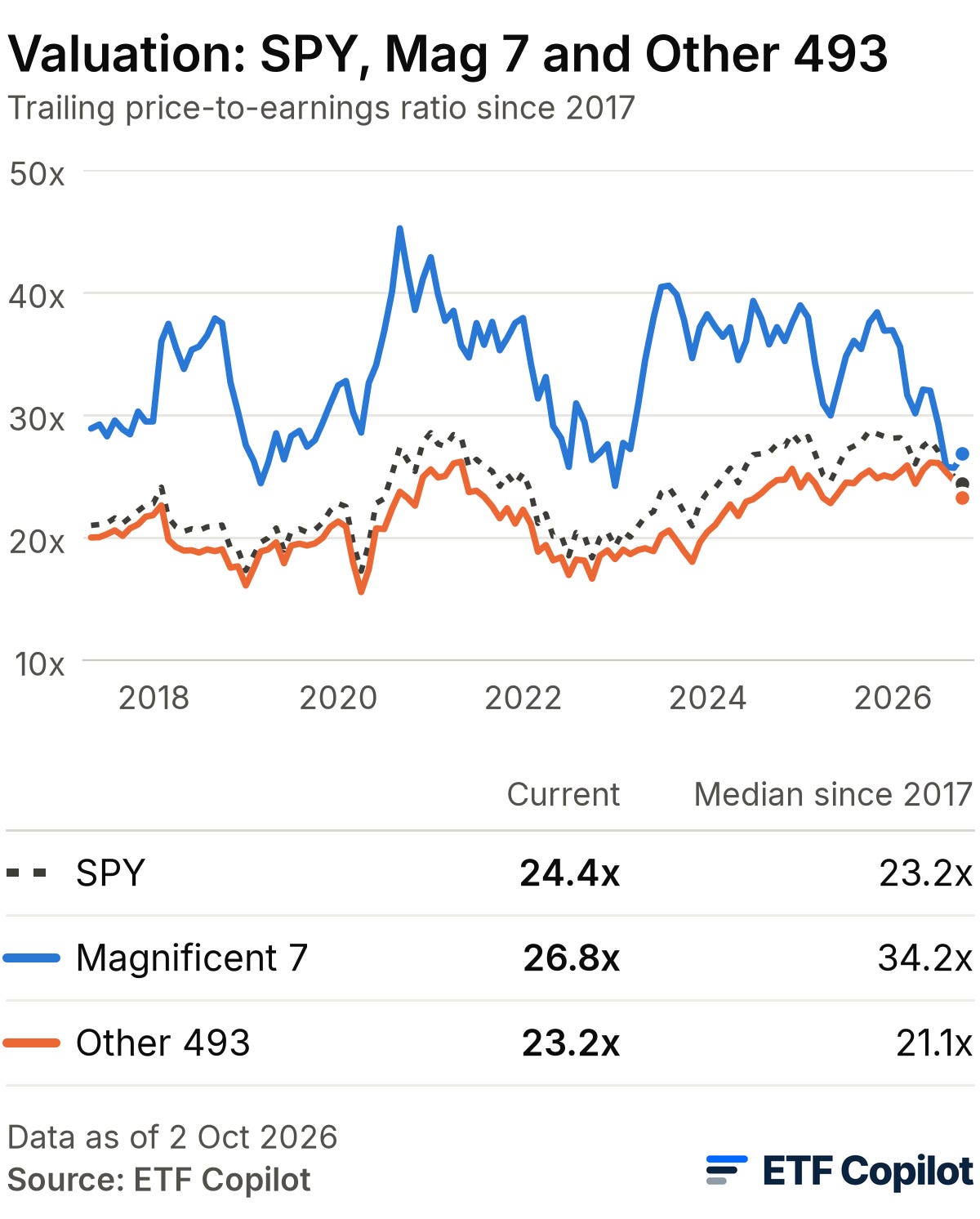
SPY’s valuation reads the same way right now. As of 2 October 2026, the fund’s holdings traded at about 24x trailing earnings, against a median of 23x since 2017: warmer than average. Split the fund in two and the forecast changes. The Magnificent 7, or Mag 7 (Apple, Microsoft, Nvidia, Alphabet, Amazon, Meta and Tesla), trade near the bottom of their own range. The other 493 stocks run warm, and the two halves have rarely been priced this close together.
The average says expensive
Start with SPY as a whole. It has stayed above its long-run median since the end of 2023, and today it is more expensive than it has been 59% of the time since 2017.
That is the number most people see, because an S&P 500 fund is how most people own these companies. On that reading alone, the market looks pricier than usual.
It is also two very different sets of businesses sharing one ticker. The Mag 7 are now about a third of SPY’s value, as much weight as the smallest 450 companies in the index combined, so the average can hide a lot.
Split it in two
The Mag 7 still trade at a higher multiple than the rest of the index, 26.8x, but that is well below their own median of 34.2x. They have been cheaper only 9% of the time since 2017.
The premium they carry over the rest of SPY has almost disappeared. Since 2017 the Mag 7’s multiple has typically sat about 12x above the other 493’s. Today the gap is under 4x. Before this summer it had never fallen below 5.6x.
A year ago the Mag 7 were close to 38x. In May, Bill Ackman’s Pershing Square took a stake in Microsoft, citing a “highly compelling valuation”. They traded at about 32x at the end of that month and have fallen about 5x since.
Part of the fall is accounting, and it flatters the Mag 7. In the second quarter Alphabet reported a $98bn gain, mostly unrealized gains on equity holdings, and Amazon $53bn of non-operating income, mostly from its Anthropic stake. Both sit in trailing earnings and pull the multiple down. Neither is operating profit, and if Anthropic lists, the stakes would be repriced every quarter, up or down.
The other 493 tell the opposite story: 23.2x against a median of 21.1x, more expensive than they have been 68% of the time since 2017. The higher multiples sit in the largest of them: Broadcom, AMD, Eli Lilly, Palantir, Walmart. So the half of SPY trading above its norm today is the half usually described as the diversified one.
What the premium buys
The Mag 7 still cost more per dollar of earnings, and the extra mostly buys growth.
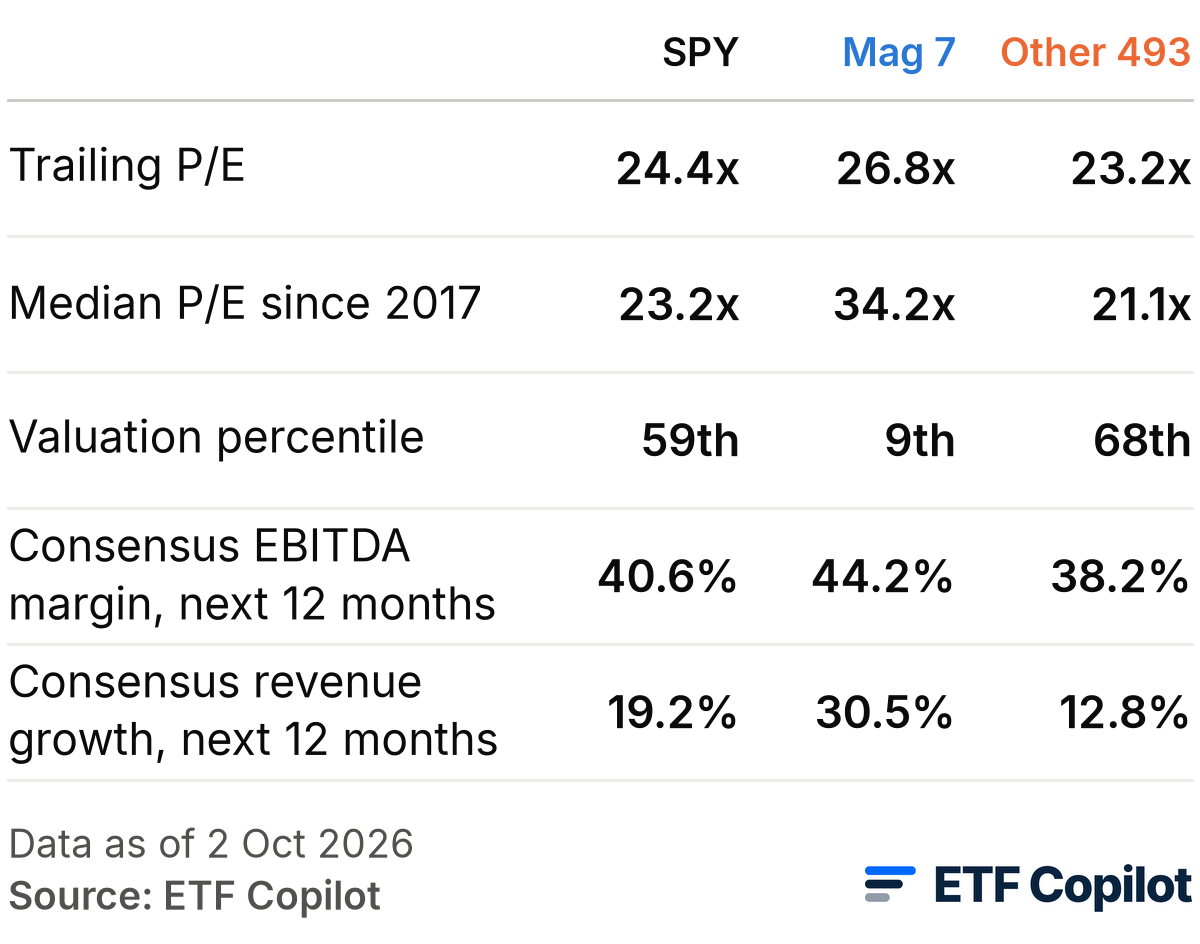
Analysts expect Mag 7 revenue to rise about 30% over the next twelve months, more than twice the 13% expected for the other 493. They also expect wider margins, though the gap there is smaller.
So the rest of SPY trades above its own history for less than half the growth, while the Mag 7 trade well below theirs.
Forecasts can miss, and concentration is the obvious risk. VOO holds a third of its weight in these seven companies, and VUG more than half, according to ETF Copilot’s Magnificent 7 exposure data. If the growth doesn’t arrive, SPY would feel it.
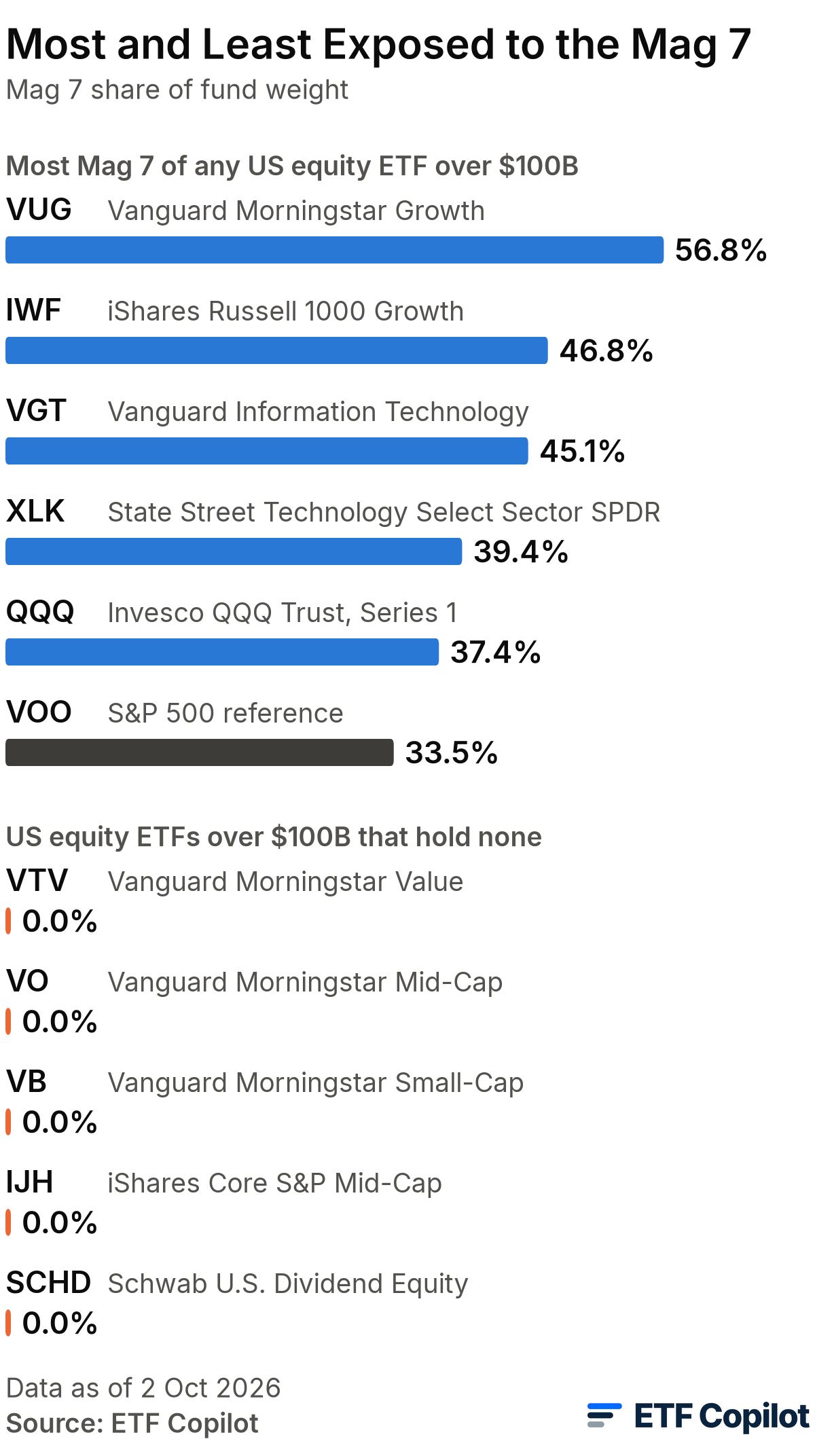
At the other end, several of the largest US equity funds hold none of the Mag 7, among them VTV, Vanguard’s value fund, and SCHD, Schwab’s dividend fund. Everything they own from the S&P 500 sits in the other 493, the half that runs warm.
For most of the past decade, asking whether the S&P 500 was expensive meant asking about seven companies. This year, it means asking about the other 493.
Written by the ETF Copilot research team. Data as of 2 October 2026. ETF Copilot has no business relationship with, and receives no compensation from, the issuers of the funds mentioned. Not investment advice.
Sources: Alphabet Q2 2026 results; Amazon Q2 2026 results; Pershing Square’s Microsoft stake (Reuters, May 2026).