
The same beach hotel may cost a third less in October. Same rooms, same view, same staff. The discount pays you for the weather.
Three ETFs are in their off-season right now. FDN, which holds the largest US internet companies, FLQM, a broad spread of mid-sized US firms, and IHI, the makers of medical devices, all trade below where they have stood for most of the past nine years. Each has its own weather: AI spending, rising rates and slower forecasts.
We looked for ETFs that are inexpensive against their own history, hold businesses that earn well and are expected to grow, and are big enough to trade easily.
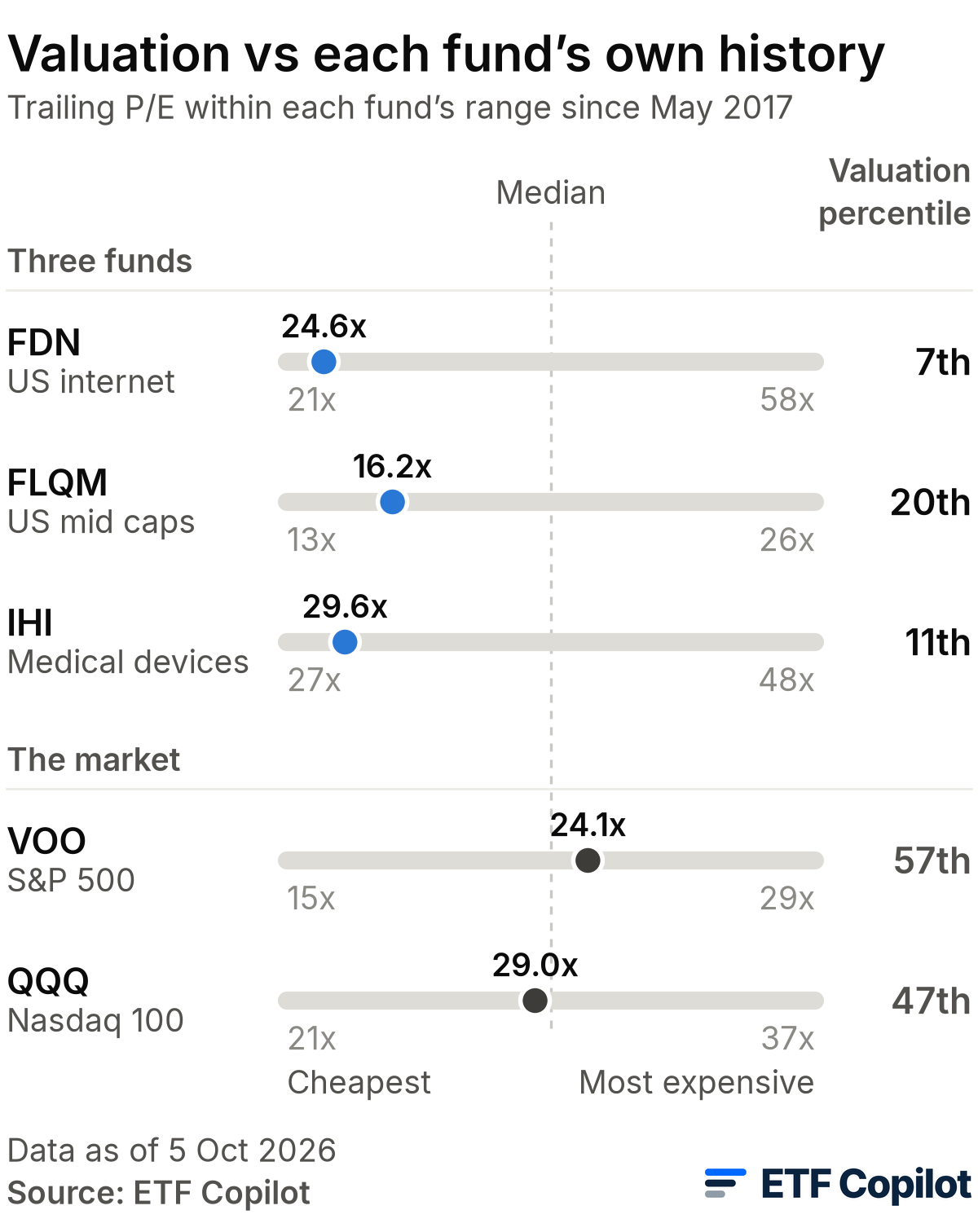
VOO, Vanguard’s S&P 500 fund, is more expensive than it has been 57% of the time since 2017, and QQQ, which tracks the Nasdaq 100, 47% of the time. On 16 September the Federal Reserve raised rates, saying inflation “remains elevated”, and higher rates tend to weigh on high multiples.
How we screened
We started with the US-listed equity ETFs we track that hold at least $1bn and have a valuation record going back before the pandemic. We kept those trading below their usual multiple whose holdings earn good returns on capital and are expected to grow earnings by double digits, then picked three from different parts of the economy.
Sorting by price alone would have been a poor starting point. Several of the cheapest funds hold gold and silver miners, cheap because high metal prices have lifted their profits, so we left commodity funds out.
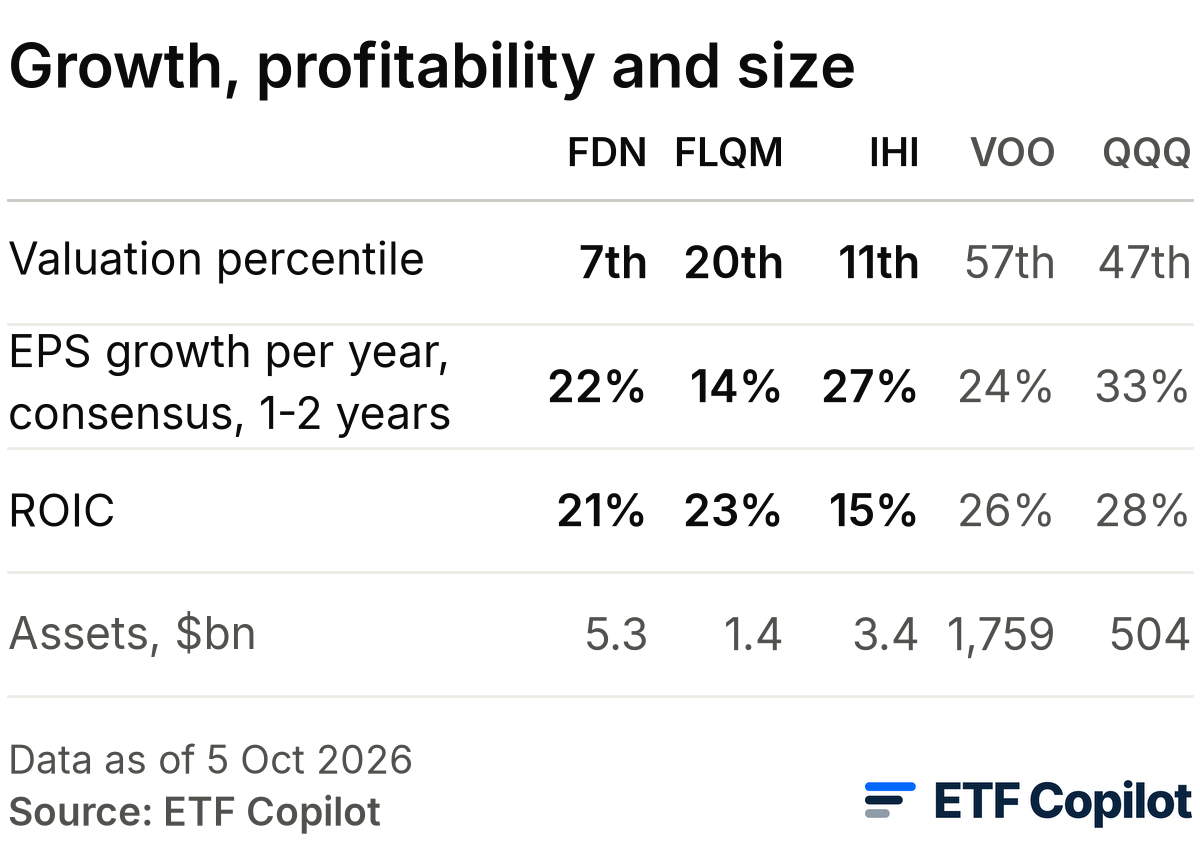
Valuation percentile: share of the time since 2017 the trailing P/E was lower than today.
FDN: internet leaders at the market’s multiple
FDN, the First Trust Dow Jones Internet fund, holds US internet companies, with Meta, Amazon and Alphabet together almost a third of it. It usually trades well above the S&P 500, with a median of 32x since 2017, and now sits at about 25x, close to VOO.
The earnings behind FDN grew by about 65% over five years while its price rose far less. Part of that growth is one-off: Alphabet and Amazon, about a third of FDN’s earnings, booked large investment gains this year.
What holds it back is the cost of AI. Meta’s second-quarter free cash flow fell to less than a tenth of the year before as its capital spending nearly doubled. Michael Burry wrote on 24 September that the world’s most profitable companies, except Apple, are “betting everything on this as their free cash flow turns negative and the borrowing pace increases.”
FLQM: mid caps with a quality filter
FLQM, Franklin’s US mid-cap multifactor fund, spreads its money across about 200 mid-sized US companies chosen mostly on quality and value. Its ten largest holdings are only 12% of the fund.
At 16x it trades below its 18.5x median since 2017, and over five years its earnings rose about as fast as the S&P 500’s, roughly 90%.
Rates are what keep it cheap. Mid-sized companies usually feel higher rates more than large ones: their profit margins are thinner, and they borrow on less generous terms. Since the Fed raised rates on 16 September, FLQM has lost about 2% while VOO gained about 3%.
IHI: medical devices after five lost years
IHI, iShares’ US medical devices fund, holds makers of surgical robots, heart devices, diabetes monitors and diagnostics, and nearly all of them are profitable. Abbott, Intuitive Surgical and Medtronic make up almost half of it.
The fund has lost about 3% a year over five years as its earnings barely moved. At 30x it trades above the S&P 500, yet below its own 35x median.
Its largest holdings explain much of the discount. Intuitive Surgical expects da Vinci procedures to grow 13.5% to 15.5% this year, slower than before, and on 22 July Johnson & Johnson won FDA clearance for Ottava, a rival surgical robot.
The forecasts deserve a second look. Analysts put IHI’s forward P/E near 23x, which makes the fund look cheaper still, yet much of that rests on adjusted earnings. Abbott, the largest holding, reported second-quarter earnings of $0.53 a share under standard accounting and $1.31 adjusted, mainly because of charges from past acquisitions.
Where that leaves the three
With the broad market near the middle of its own record, these three funds stand out on valuation and on the businesses they hold. The weather that made them cheap is real: the cost of the AI build-out for FDN, higher rates for FLQM and generous forecasts for IHI. How long it lasts is the question each investor has to weigh.
Written by the ETF Copilot research team. Data as of 5 October 2026. ETF Copilot has no business relationship with, and receives no compensation from, the issuers of the funds mentioned. Not investment advice.
Sources: Michael Burry, 24 Sep 2026; FOMC statement and projections, 16 Sep 2026; Meta (2026, 2025), Alphabet, Amazon, Intuitive and Abbott Q2 2026 results; Johnson & Johnson, Ottava clearance.