
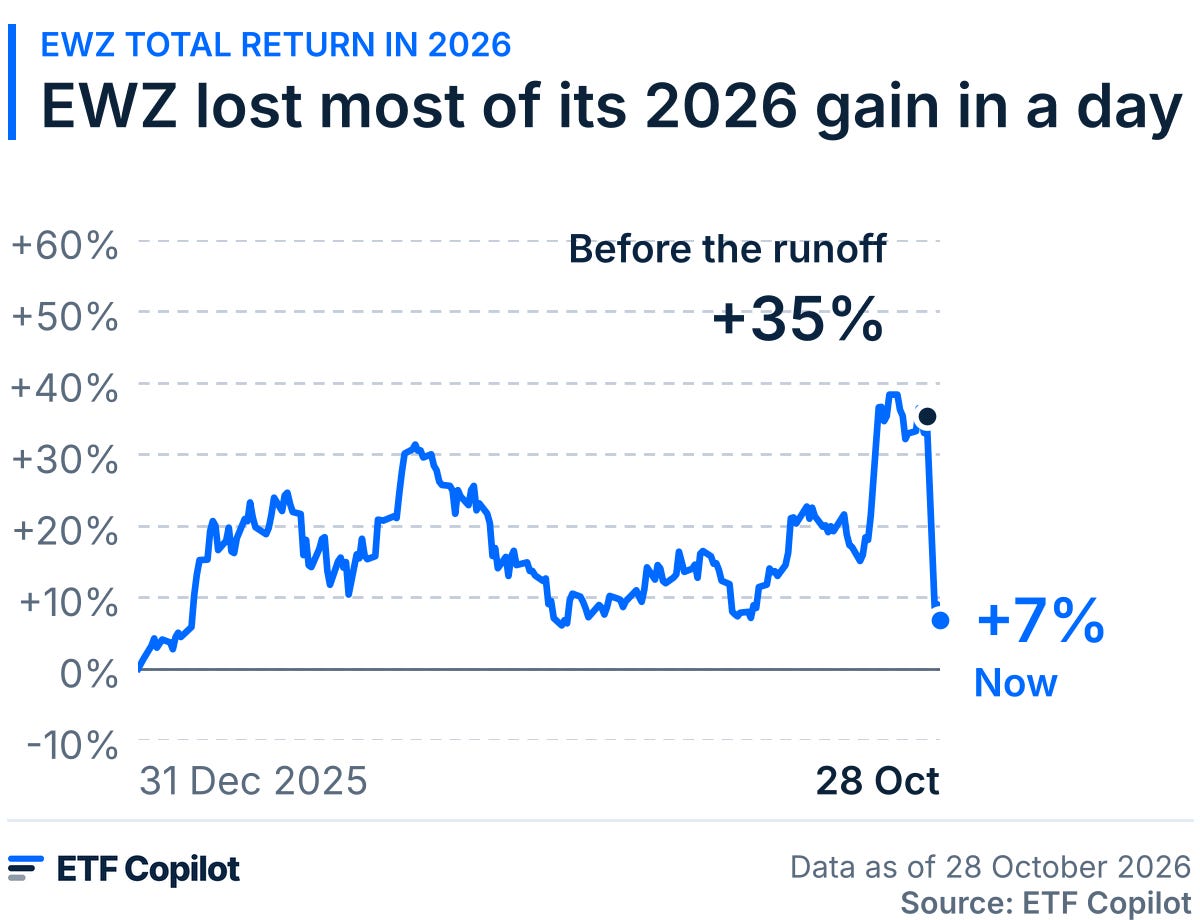
Before Brazil's presidential runoff, Citi asked 73 fund managers what a win by Luiz Inácio Lula da Silva would do to the market. Eight in ten expected a fall of more than 5%. On Monday, after Lula won a fourth term, EWZ, the largest US-listed Brazil ETF, fell 20%.
It was the fund's worst day since the pandemic crash of March 2020.
A bet on change
The bet started with the first round on 4 October. Senator Flávio Bolsonaro took 47% of the vote to Lula's 45%, a better result than polls had predicted. Investors read it as a likely change of government and a tighter budget, which would let Brazil's central bank cut interest rates faster. The next day EWZ jumped 12.5%, led by the banks.
By the Friday before the runoff, EWZ had returned 35% this year, nearly three times the S&P 500's gain. Then Lula won with 51.8% of the vote.
Two hits in one day
EWZ holds Brazilian companies but trades in dollars, so the result hit it twice. In São Paulo, the Ibovespa index fell 13.9%, and a 10% drop in the morning set off the first trading halt since March 2020. The real lost about 8% against the dollar, its biggest one-day drop since at least 2020. In dollars, the two losses stacked up to EWZ's 20% fall.
Banks first, exporters last
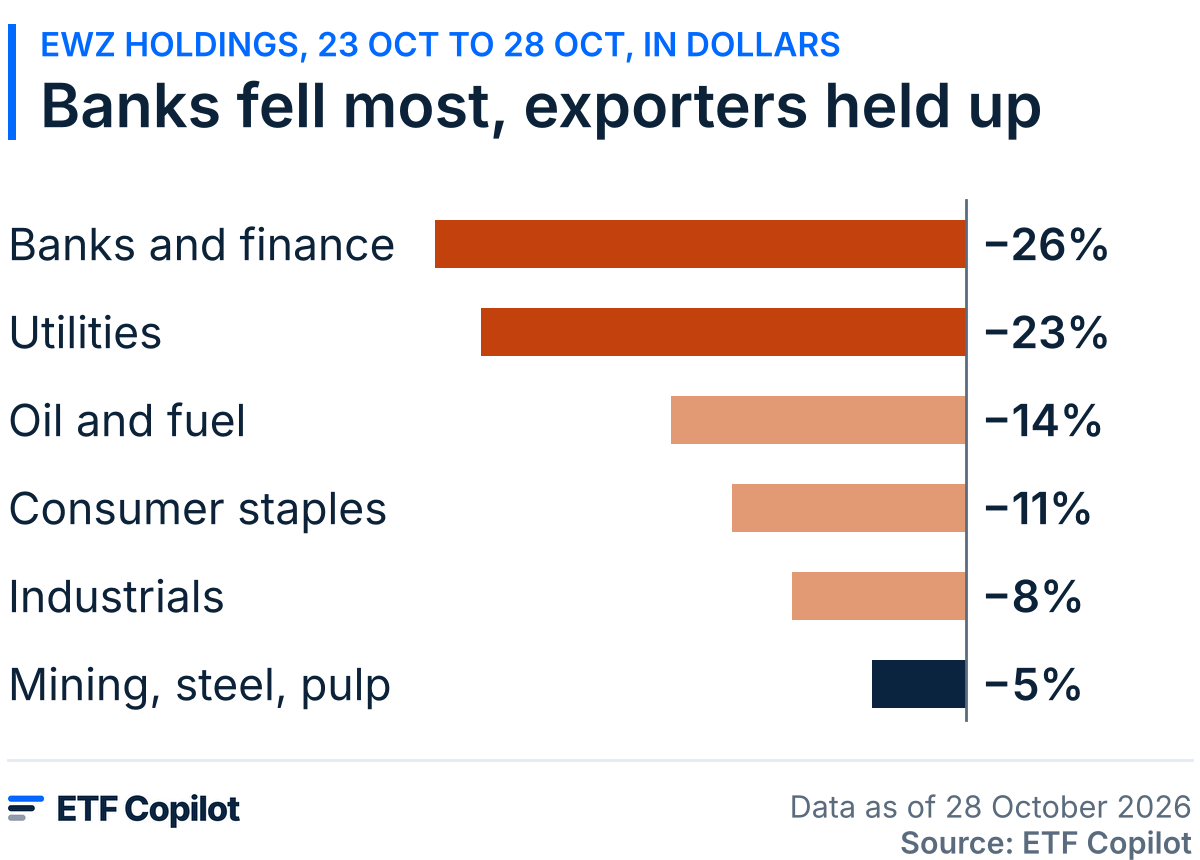
The selling sorted EWZ's companies by one question: do they live off the Brazilian economy, or get paid in dollars? Banks and other financial companies, a third of the fund, have lost about a quarter of their dollar value since the Friday before the vote. Utilities fell nearly as far. Lenders depend on domestic credit and on interest rates, so a weaker budget outlook lands on them first.
At the other end, WEG, Embraer and Suzano rose in dollars. They sell much of what they make abroad, so a cheaper real lifts their earnings counted in reais.
Cheaper, on one condition
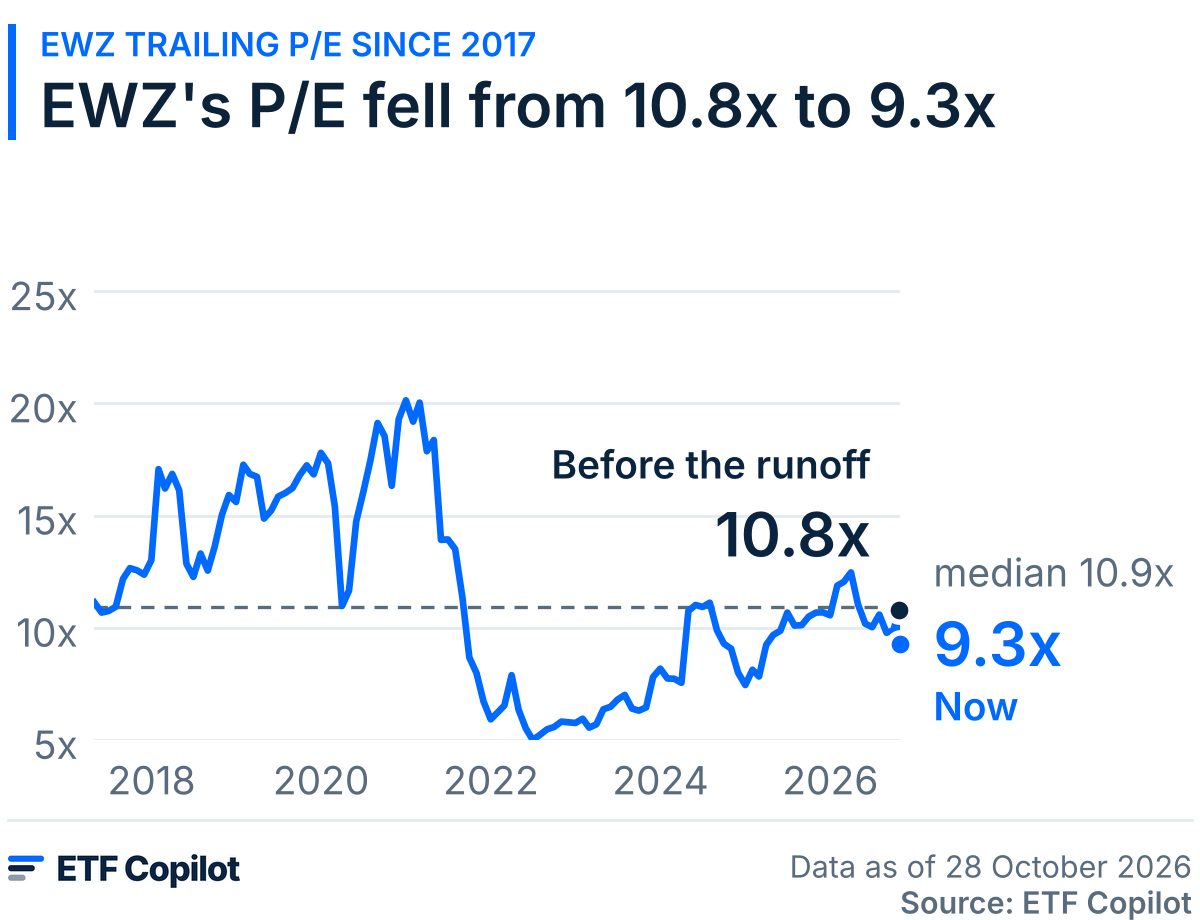
The fall left EWZ cheaper. Its trailing P/E dropped from 10.8x before the runoff to 9.3x, its lowest since April 2025 and below its median of 10.9x since 2017. That is a 14% drop against the fund's 20%, because the P/E compares share prices and earnings both in reais: it tracks Brazilian share prices and leaves out the real's slide.
Whether that discount holds depends on the budget. Brazil's gross public debt is above 82% of GDP, and in January the Treasury projected 83.6% for this year. Interest rates are already high: the central bank's Selic rate stands at 13.75% even after five cuts in a row. "Investors need a revised fiscal framework that generates primary surpluses sufficient to stabilise debt," said Viktor Szabó of Aberdeen Investments.
The first signal comes before any budget: Lula's choice of finance minister, where investors will look next.
In 2022, Brazil's market cheered a Bolsonaro first round and lost the runoff. This October it made the same bet, and paid more for it.
See the full breakdown on ETF Copilot: etf-copilot.com/go/substack/ewz-brazil-selloff
Written by the ETF Copilot research team. Data as of 28 October 2026. This is not investment advice or a recommendation to buy or sell any security. ETF Copilot receives no compensation from the issuers of the funds mentioned. Managers of ETF Copilot may or may not hold positions in the funds mentioned.
Sources: MercoPress on the first round, 5 October 2026; MercoPress on the market after the runoff, 26 October 2026; runoff result, 26 October 2026; The Rio Times on the 26 October session; MercoPress on Lula's economic challenges, 26 October 2026; Brazil Treasury debt projection, 12 January 2026; Al Jazeera, 26 October 2026.