
Picture a ski resort that has sold out every winter for three years, with this season fully booked too. Then a long-range forecast calls for a warm winter three seasons from now, and the resort’s shares tumble. Chip stocks are living through a version of that.
The Philadelphia Semiconductor Index, the main gauge of chip stocks, lost about 10% in the six trading days to 14 October, and memory makers lost far more. A hotter inflation report that day added fuel by reviving talk of higher interest rates.
Three years at the center of the market
Chips have carried the market for three years. SMH, VanEck’s semiconductor fund, nearly quadrupled over that span, a return of 57% a year. SOXX, the iShares chip fund, more than tripled.
Two kinds of company did much of the work: Nvidia, whose chips run AI models, and the memory makers Micron and SK Hynix, whose chips feed those models their data. Together they are 28% of SMH and 18% of SOXX.
For three years investors have asked how long this could last. So far the answer has come from earnings.
Earnings grew faster than prices
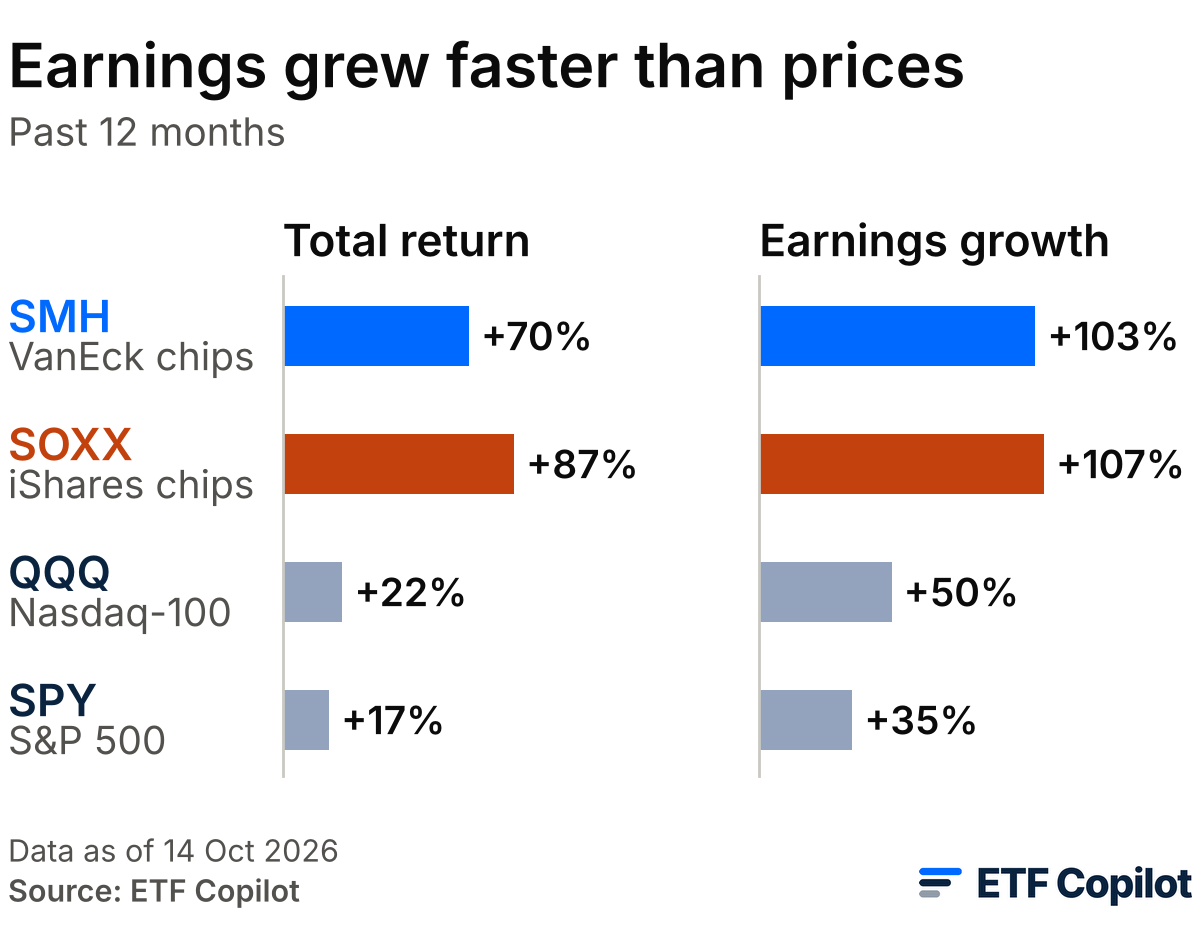
In the year to 14 October 2026, SMH returned 70% and the earnings of the companies inside roughly doubled. SOXX returned 87%, with earnings up slightly more than SMH’s.
That is why the funds got cheaper while prices climbed: SMH’s trailing P/E went from 38x a year ago to 32x. Over the same year the S&P 500’s earnings rose about a third.
Memory turned first
The selloff hit memory hardest. Over the five days to 15 October, SK Hynix fell 26%, Samsung 22% and Micron about 11%.
Two worries landed at once. CXMT, China’s leading memory maker, unveiled a denser chip design it plans to bring to servers by the end of the year, raising the prospect that it takes market share from Samsung, SK Hynix and Micron. Then a column in South Korea’s Maeil Business Newspaper, citing industry experts, warned of a glut of new capacity by 2029 and urged the country to find its next growth engine. Elon Musk weighed in on X: “China will be making a LOT of RAM in 2028.”
Inside the industry, the shortage still looks persistent. Analysts at Quilter Cheviot and Rosenblatt Securities doubt CXMT can make the new design at scale soon enough to tip supply and demand. Micron’s chief executive, Sanjay Mehrotra, said on 30 September that “in calendar year 27 as well as 2028, we see demand exceeding supply.” DRAM contract prices rose about a fifth in the three months to October, according to Barclays data.
Memory has long been a boom-and-bust business, and investors are pricing the bust years ahead. Inside SMH, the memory makers’ trailing P/E fell from about 32x in June to 8.5x, as their profits kept climbing and their shares fell.
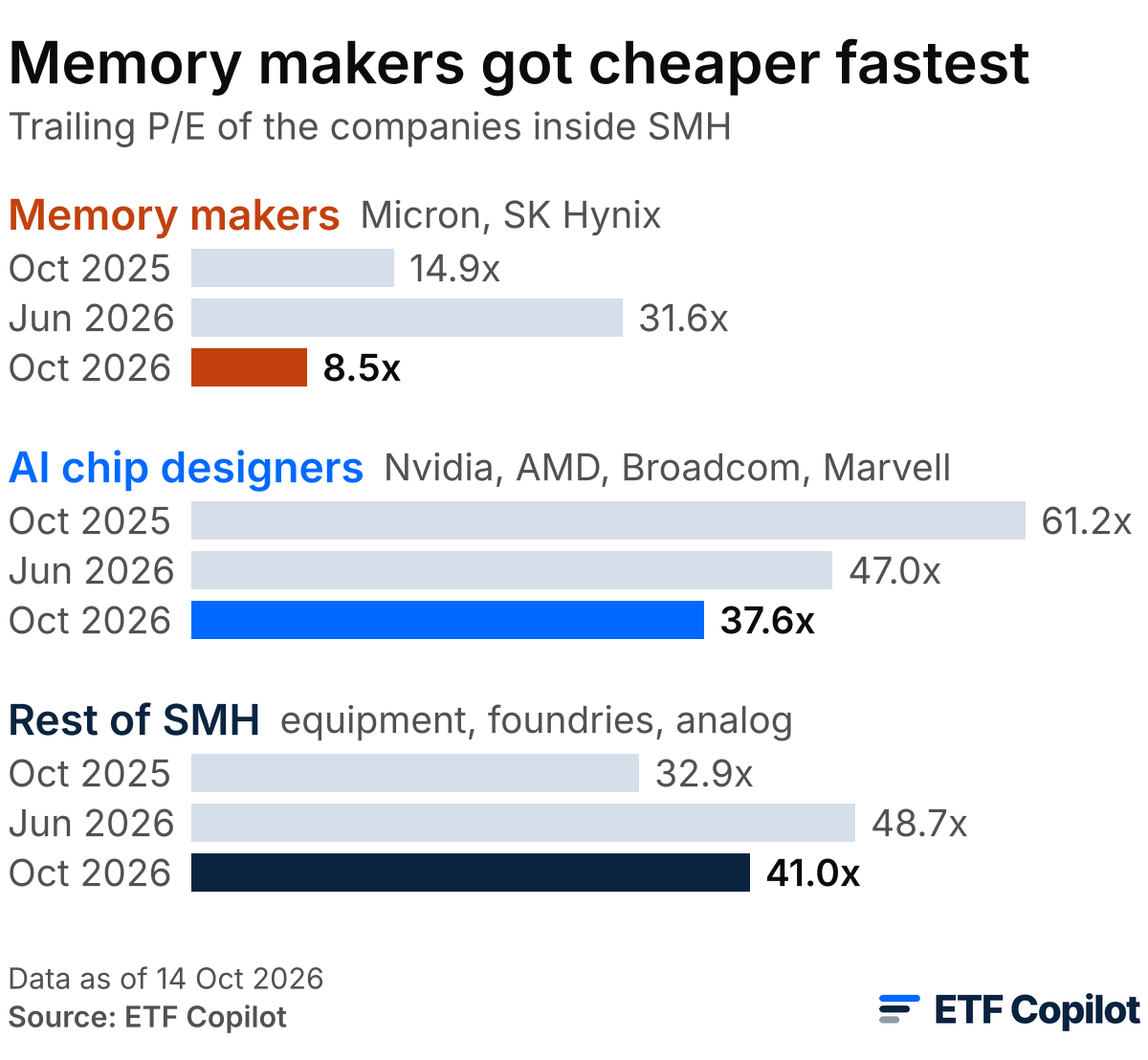
On Micron’s own guidance for this quarter, its shares trade at about 6x a year of earnings, with a gross margin of 87% against 46% a year earlier. The price assumes those profits fade.
The AI chip designers, Nvidia among them, also got cheaper: their trailing P/E is 38x, down from 61x a year ago, because their profits rose faster than their shares.
Is it a bubble?
In a bubble, prices run ahead of earnings. Over the past year chip stocks did the opposite.
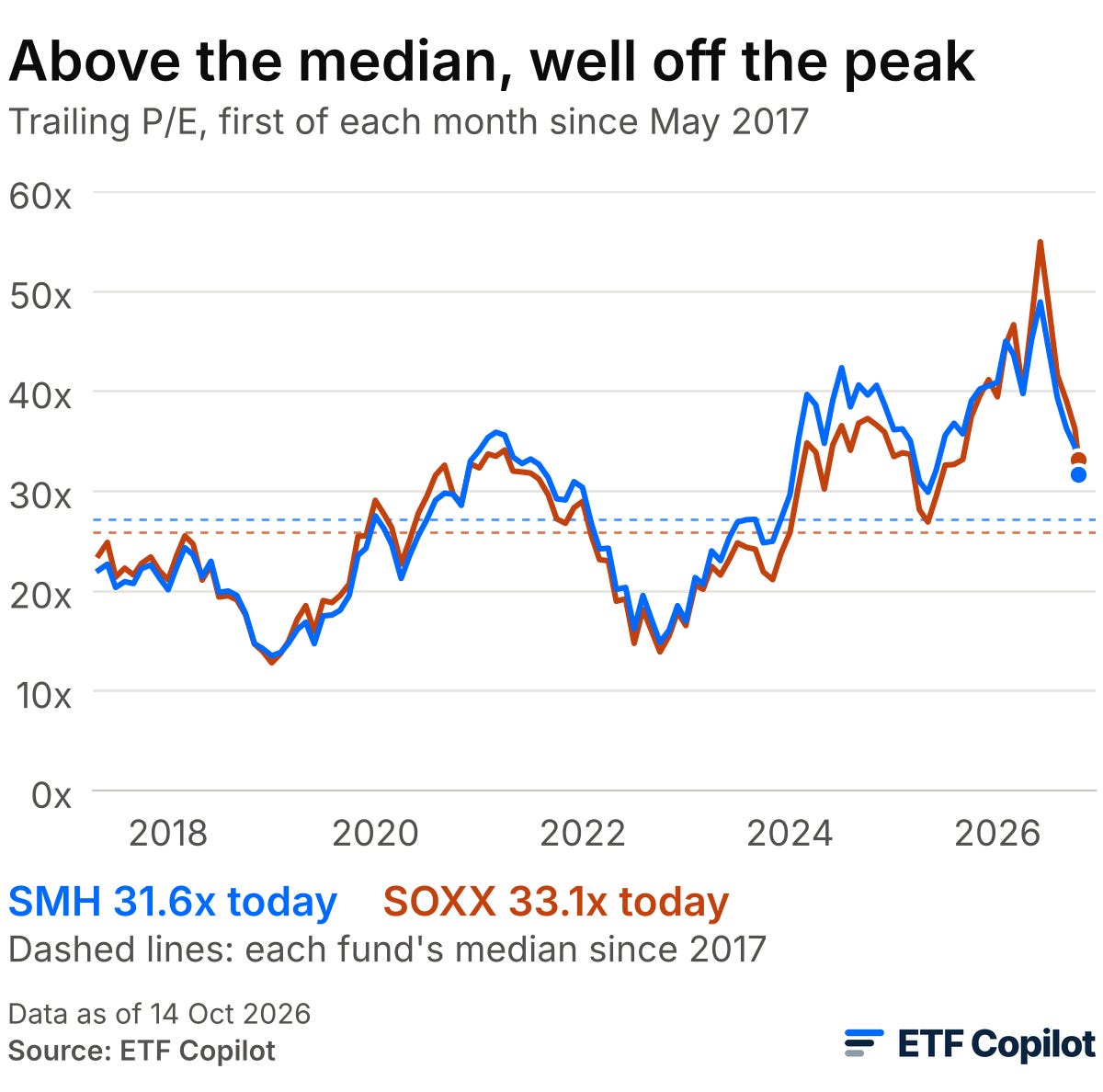
They are still expensive against their own history. SMH’s trailing P/E is higher than 64% of its monthly readings since 2017, and SOXX’s higher than 74%. Both are well below the June peak, when SMH reached 49x.
The companies’ own outlooks still point up. TSMC reported on 15 October and guided fourth-quarter revenue to $52.3 billion to $54.3 billion, up from $46.7 billion in the third quarter. A day earlier ASML’s chief executive, Christophe Fouquet, said customers are raising their demand forecasts, “driven primarily by their views on the size and duration of AI-related investments.”
UBS’s wealth-management arm called this week’s drop a recalibration of expectations, with the AI investment story intact.
What would turn it into a bubble is earnings that stop arriving. Profits at the top of a cycle are the easiest to lose, and memory’s single-digit multiple says investors already doubt part of them. Chip funds fall hard when that happens: in the year to October 2022, SMH and SOXX each lost a third.
Where this leaves chip investors
For now the selloff looks like investors marking down the far end of the cycle while profits are still rising. The coming earnings reports are the test. If results keep pace with guidance, today’s prices rest on firmer ground than June’s peak did. If memory turns as early as the skeptics fear, the companies that led the climb may lead the fall.
To see how exposed each fund is to Nvidia and the memory makers, our SMH vs SOXX comparison lines up what each holds, where the two overlap, and how their valuations and fees compare.
Written by the ETF Copilot research team. Data as of 14 October 2026. This is not investment advice or a recommendation to buy or sell any security. ETF Copilot receives no compensation from the issuers of the funds mentioned. Managers of ETF Copilot may or may not hold positions in the funds mentioned.
Sources: Elon Musk on X, 14 Oct 2026; memory stocks, CXMT and the Maeil column, CNBC, 15 Oct 2026; Maeil Business Newspaper column; CXMT, and Micron’s 30 Sep results and guidance, 24/7 Wall St., 12 Oct 2026; DRAM contract prices, Barclays via Wccftech, 12 Oct 2026; TSMC third-quarter 2026 results; ASML third-quarter 2026 results; Consumer Price Index, September 2026, BLS; Philadelphia Semiconductor Index, Quartz, 14 Oct 2026; rate fears and UBS view, Stocktwits, 14 Oct 2026.